Is it contradictory to feel while researching—to be attached to the organisms you study, to grieve for vanishing species, to hate killing animals, to feel so alive and grounded after a day out in the field, smelling and touching the soil? I feel that we need to talk more about this side of science. And here we go, feeling already dropped. It is almost impossible not to feel and express this personal, subjective side when talking, describing, and being. Science tries to cut this side off, though, intending to be rational and to cancel out the subjective researcher. For the reproducibility of experiments, this is undoubtedly crucial. However, if you are not careful and continue this practice outside the actual research and into your personal life, you risk cutting yourself off from some very powerful sources of energy, motivation, hope, endurance, and resilience.
This is happening to many scientists—and maybe to people outside of academia too—who are perhaps too overwhelmed to care or too disconnected to feel. But maybe, if we allow the feeling side of science to exist, we would have more stamina and perseverance to see through the not-so-easy working conditions in academia, the so-often very grim results (especially when working on biodiversity), and to fight against depression. By connecting with our feelings as scientists, we might also open doors to connect with more-than-human beings and with the hearts of fellow researchers, likely sitting in a very similar boat. Maybe some beautiful collaborations could emerge.
If scientists were to share more of this side of the coin—the personal, emotional side of science—it might help to tear down some of the walls built around the silo or ivory tower of science. It feels like a wave of emotion, connection, and growing consciousness that, once initiated, travels against all odds through the ocean. We need more practices of empathy that teach us how to allow feelings, creating habits that make emotional awareness possible.
This summer, I was invited to a summer school in Rome on activism in science. This might sound contradictory, but science and research institutions play an important role in shaping society’s morals and values, and in setting examples. Palestine and the ongoing genocide were, rightly, the dominating topics. How can universities take a stand, boycott, and help lead society forward?
My task at the conference was to speak about emotions in science (also loosely connected to my blog, as my friend and colleague organizing the summer school was an early follower). My goal was to show connections, benefits, and inspiration from different authors—mostly Indigenous voices—who share how instinct and emotion are included in knowledge production. I also wanted to share my own work: my poems and the soil safaris I run with children to bring them closer to soil life.
In my lecture, I introduced the concept of research creation, a methodology that not only acknowledges but actively cultivates emotional awareness as part of academic rigor. It combines artistic and scholarly practice, using methods such as storytelling, visual art, and performance, while holding space for vulnerability, beauty, and rage. These practices can take many forms, for example through story circles and co-writing, art as fieldwork, or other creative rituals for grounding. There are many excellent books exploring different forms of science, traditional knowledge, and alternative ways of thinking about research. I especially recommended the following to the students:
- We Will Be Jaguars by Nemonte Nenquimo
- Braiding Sweetgrass by Robin Wall Kimmerer
- Sand Talk by Tyson Yunkaporta
After the theoretical part of my lecture (see slides below), what better way to connect with practice and break out of the indoor classroom dullness than by going outside for a small soil safari? Three challenges quickly became apparent:
- Most participants were law students, not particularly familiar with life sciences or with putting their hands in the ground.
- It was the end of July in Rome, with 40°C even in the shade.
- The university’s perfectly curated vegetable garden was not meant to be touched—more of a museum or decorative space, I suspect.
We found a small corner anyway, and off we went, searching for soil life. Given the sterile and dry conditions, we didn’t find much beyond a few ants… Still, it was lots of fun (In case you want know more how soil safari works etc. – I share more details here, and in another article what I feel when working in the field.)
The summer school was really great, a great little possibility to learn outside-the-box thinking and to share and connect with very interesting, creative people. Thanks for the invite and for having me!


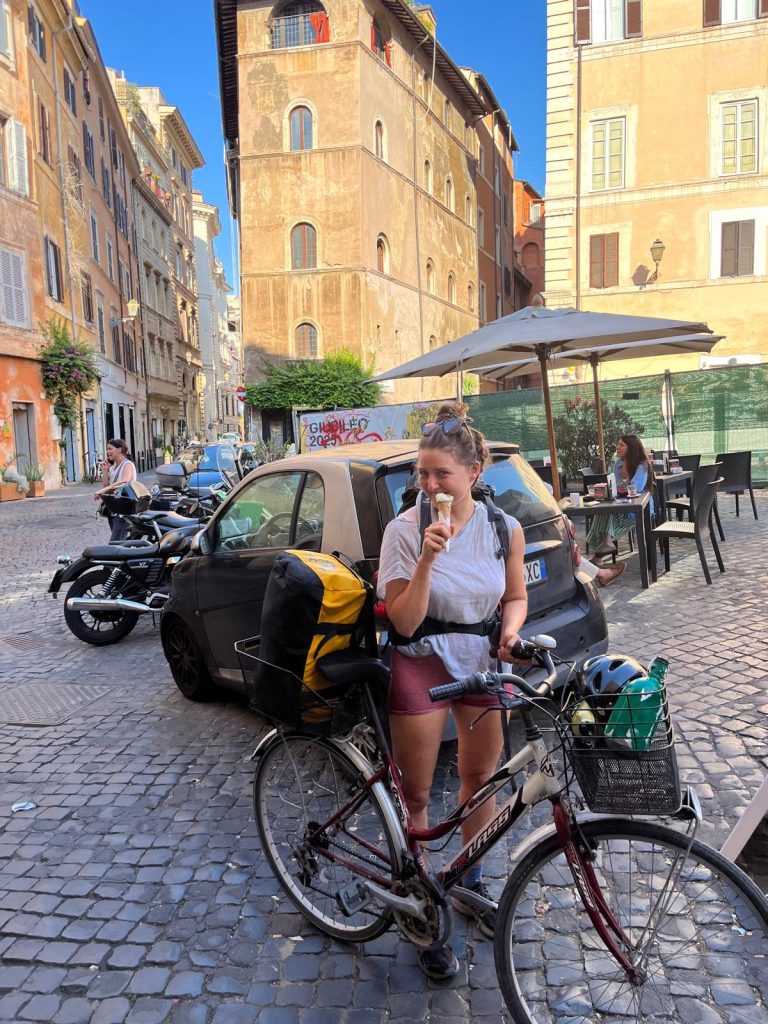
Now to the eternally loved city. Rome for me is this perfect chaos. Perfectly beautiful architecture and a total mess of too many people, co-existing with remnant, other forms of life wildly making their way. It also means this weird mix of all sorts of memories for me. It was the first city, I have been to with 14 without my parents abroad, first time really feeling foreign and lost in language-terms. Then the first city I went to on my own doing a 2-week language course after my Bachelors, overcoming this language barrier. And then the destination of many more escapes from Germany where I just always found back and maybe also lost a bit another part of me. This time summer Rome, I was able to cycle a lot, I just love the cycling path along the Tiber. Its so efficient, fast, beautiful – this is what a cycleable city should look like (but still, considering Rome as the peak of Italian crazy driving – better bring your helmet). Here some random city beauty:


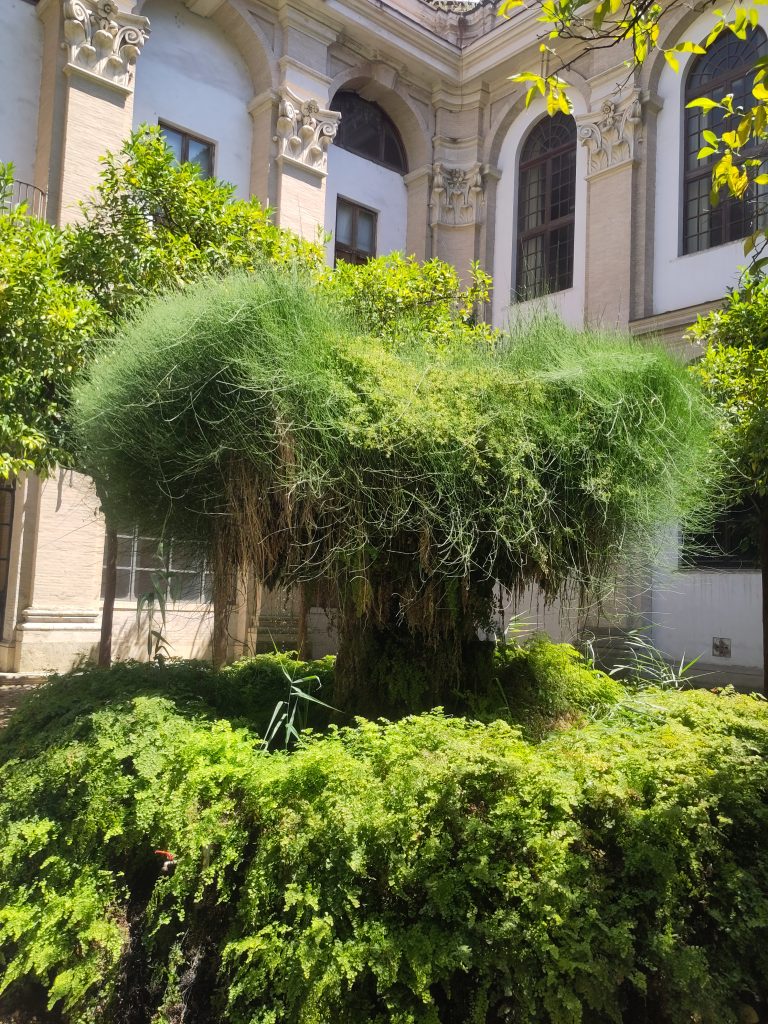
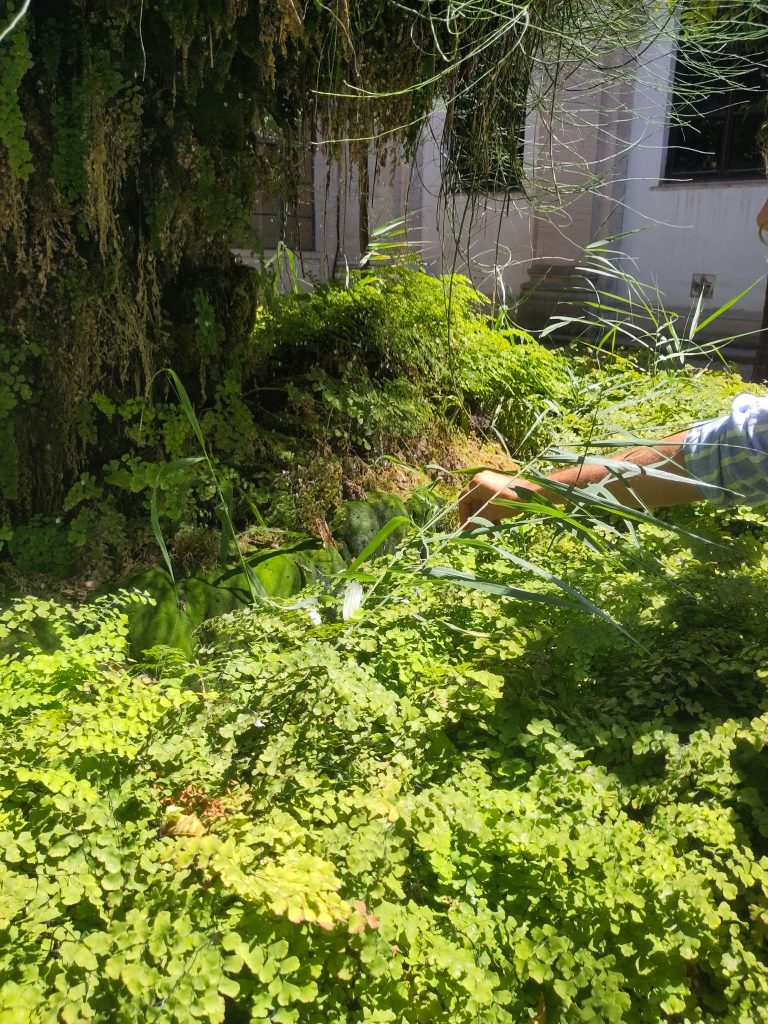
This little green oasis in the middle of this old-town library, gelato and some muscle sculpture beauties.

And some night strawling Oleander-architecture-light-kitsch.


Oh Rome, you just got my heart, eternally.
Here are my slides of the presentations I gave at the summer school: